
Equine influenza
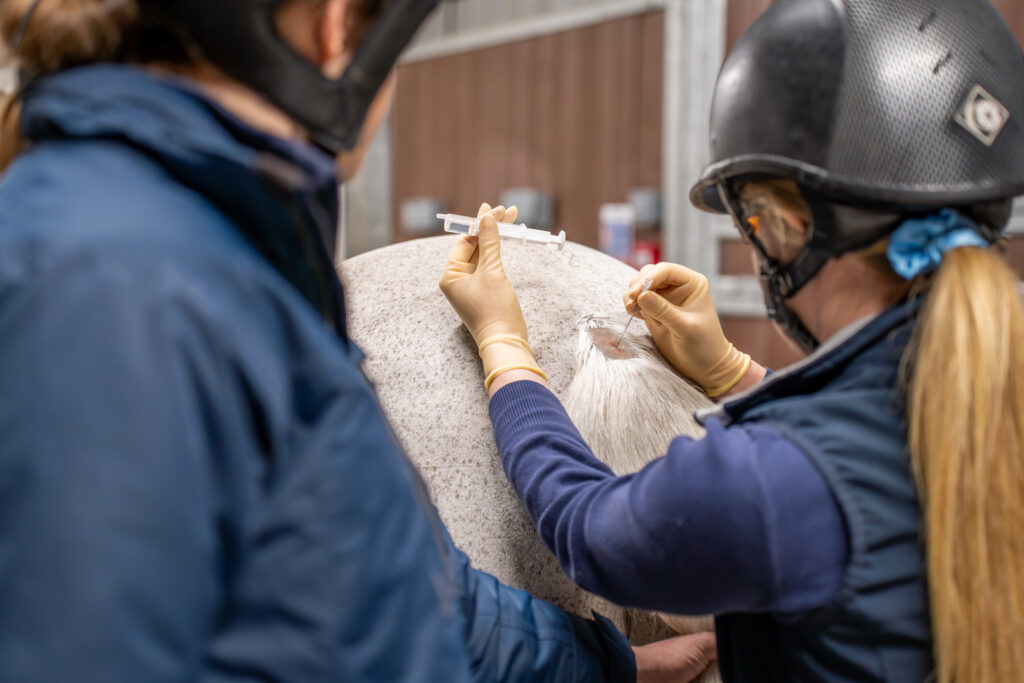
Equine influenza is a highly contagious respiratory infection associated with coughing and a fever.
This infection spreads rapidly between unvaccinated horses and, although not usually life-threatening, can be very debilitating and lead to affected animals being rested for several weeks.
Foals can begin their vaccinations when they are four to six months of age.
Protection against equine influenza usually requires:
- A primary course of two injections approximately one month apart.
- A third injection approximately 5-7months after the second injection.
- Annual boosters within 365 days of the last booster.
Following the outbreak in 2019, many regulatory bodies and competition centres require horses to have six-monthly boosters to reduce the risk of transmission of the disease at the event. We encourage owners to check with the various governing bodies (e.g. British Horseracing Authority, FEI, British Eventing, British Showjumping, British Riding Clubs, etc.) as to the specific vaccination requirements for their horse to avoid disruption to their competition work.
It is the horse’s owner’s responsibility to make sure that the horse’s vaccinations are up-to-date in accordance with the relevant rule books.
If any of the vaccinations are late, the horse will have to restart the vaccination course to be up-to-date.
Tetanus
Tetanus is usually fatal and occurs when a bacterium in the soil, Clostridium tetani, enters a wound and produces toxins. The foot is a common entry site, but the bacteria have the potential to enter any wound.
The risk of tetanus is significant – approximately 90% of unvaccinated horses who contract tetanus do not survive. We therefore strongly recommend that all horses, regardless of their lifestyle and how often they travel or mix, be vaccinated against tetanus.
The initial vaccination course is two vaccinations 4-6 weeks apart, and a third vaccination is usually given 18 months later. Thereafter, a booster every two years is required.
Brood mares should have a booster four to six weeks before foaling to provide the foal with some protection from birth. Foals can start their own vaccination course from six months of age.
Tetanus and influenza vaccinations are often given at the same time, as most manufacturers produce a combination product.
Horses will alternate each year between influenza vaccination on its own and the combination vaccine, enabling yearly flu boosters and every other year tetanus vaccination.
Equine herpes virus
Equine herpes virus (EHV) can cause abortion, respiratory disease and occasionally neurological disease.
Vaccination can guard against abortion and respiratory infection; however, it cannot prevent neurological disease.
Brood mares should receive a vaccination during the fifth, seventh and ninth months of pregnancy to help prevent abortion caused by the herpes virus.
To protect against respiratory disease, horses receive two doses 4-6 weeks apart, followed by a booster every six months.
Vaccination can commence from five months of age.
Equine rotavirus
Equine rotavirus causes diarrhoea in foals, particularly where lots of foals are kept together, such as large studs.
Brood mares can receive a vaccination during the eighth, ninth and tenth months of pregnancy to prevent infection in foals.
This boosts the amount of antibodies to rotavirus that the mare produces in her milk.
Whether this vaccination is necessary for your mare should be discussed with one of the veterinary surgeons.
To learn more or discuss your horses’ individual requirements, please contact our equine team on 01509 812445.